

AI consulting is paid advice, and sometimes paid building, that helps a business decide where to use AI and then put it to work. For a service business, the best first buy is one narrow agent that does one repeat job, like following up with new leads. Skip the big strategy deck. Buy one thing that runs.
Here is the problem with most advice on this topic. It is written for big companies with big teams. You run an agency, a recruiting firm, a clinic or a home service company. You have 5 to 50 people. You do not need a 90 page report. You need the lead follow-up to stop falling through the cracks. For a broader look at where small firms should begin, see AI for small business: where to start without wasting money.
This guide tells you what to buy first, what to skip, how to pick a partner, and what to ask before you pay.
What does AI consulting actually include?
AI consulting usually includes three parts: finding the right jobs for AI, building or setting up the tools, and training your team to run them. If you are weighing AI automation services for your firm, first check what they include and what they cost in time.
Take a recruiting firm with 12 people. Every week, recruiters spend hours writing the same follow-up emails to candidates and clients. A consultant looks at that work and picks the jobs AI can do well. Then someone builds an agent to do one of those jobs. Then your team learns how to watch it and fix it.
That is the whole thing. The three parts look like this:
- Discovery. Someone maps your repeat work and ranks it by time saved.
- Build. Someone sets up the agent, connects it to your tools, and tests it.
- Handoff. Someone teaches your staff to run it so you are not stuck.
Some firms only do the first part. They hand you a plan and leave. Some do all three. For a small business, the build is where the value is. A plan with no build is a to-do list you still have to pay someone to do.
Why should a service business hire an AI consultant at all?
A service business should hire one when the owner knows AI matters but does not know what to build first or who to trust to build it.
That is a common spot. Microsoft's 2025 Work Trend Index surveyed workers across 31 markets. In it, 24% of leaders said their companies had deployed AI organization-wide, while 12% said they were still in pilot mode. So many firms sit somewhere in the middle. They have tried some tools. They have not built a system.
The same survey found that most leaders expect agents to be moderately or extensively part of their company's AI plan within 12 to 18 months. Your competitors are reading the same numbers. The firm that gets one agent live this quarter learns faster than the firm that waits for a perfect plan.
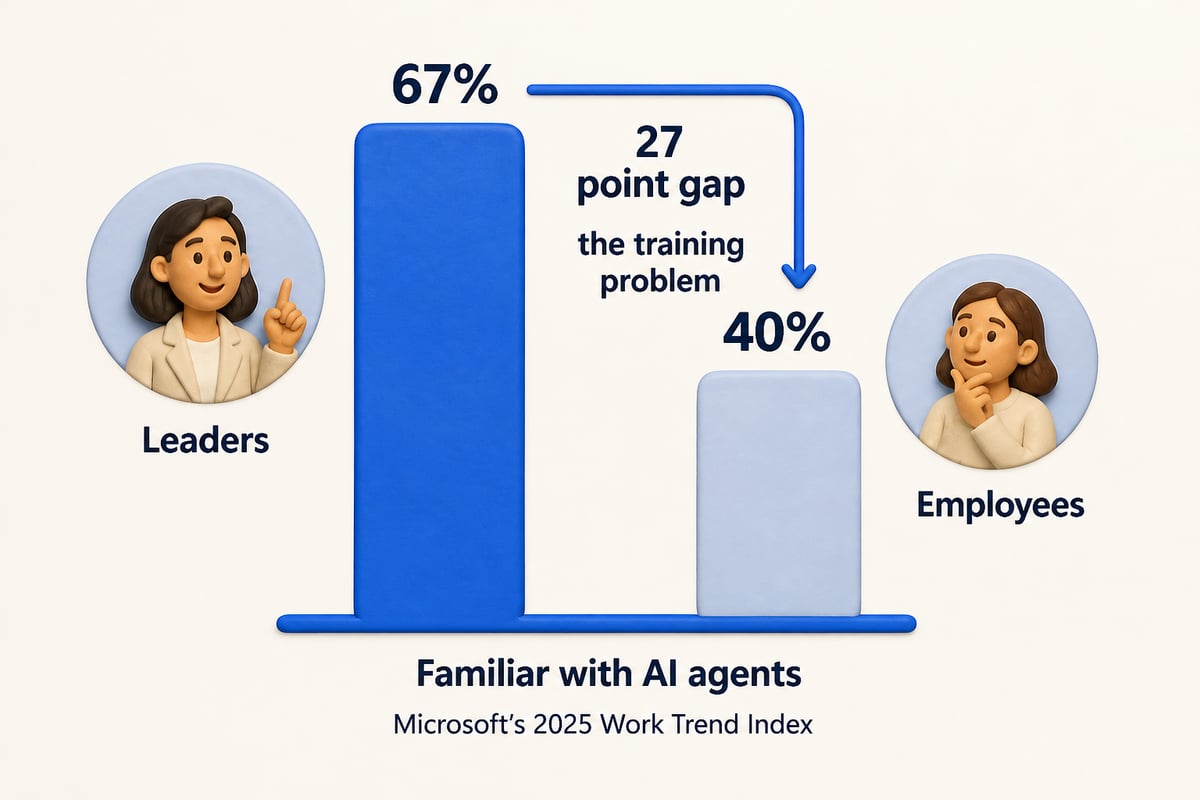
There is also a gap inside companies. Microsoft reported that leaders were far more familiar with AI agents than employees were. If you buy a tool and never train your team, that gap stays open. Good consulting closes it.
What should you buy first from AI consulting?
Buy one narrow agent for one repeat job that costs you money today, and start with lead follow-up if you are unsure.
Here is a real pattern. A marketing agency gets 60 form fills a month. Sales takes a day or two to reply. By then, half the leads have talked to another agency. An agent that replies in two minutes, asks two qualifying questions, and books a call fixes that. You can measure it. Replies go from two days to two minutes. Booked calls go up or they do not.
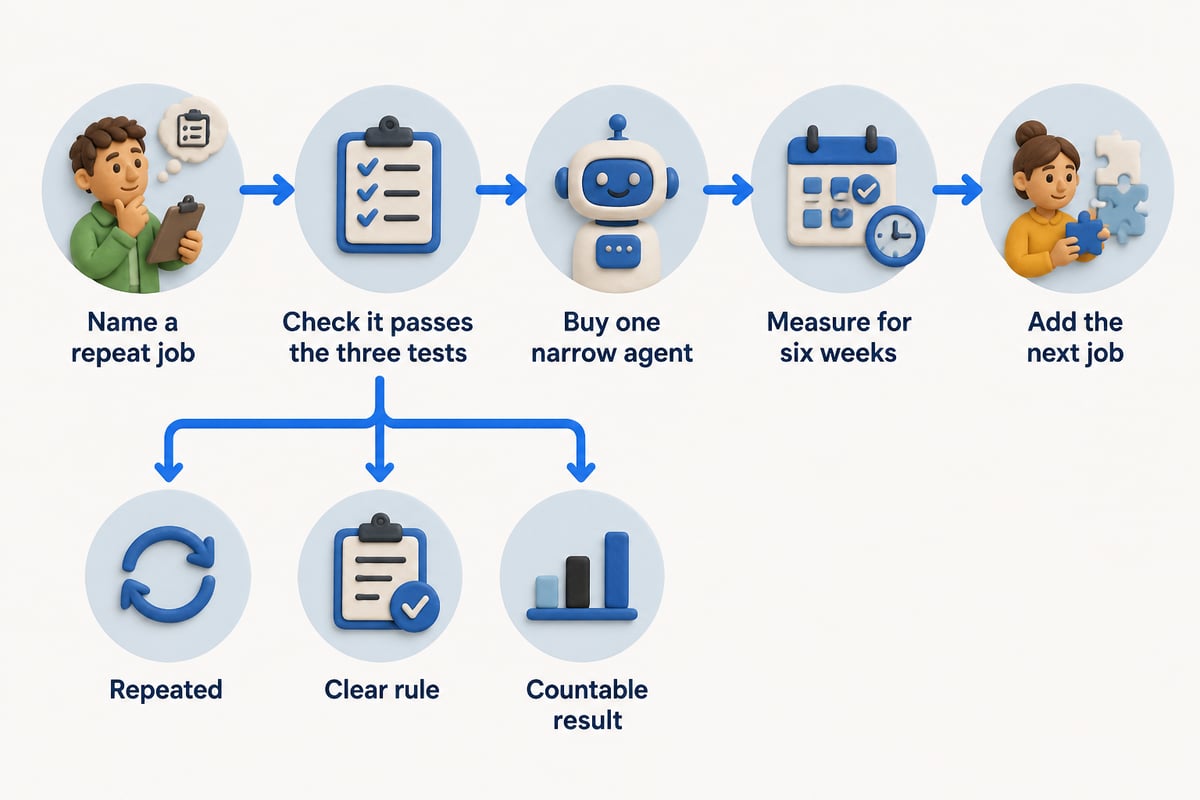
Pick your first job using three tests:
- Is it repeated every day or every week? One-off work is a bad first target.
- Does a clear rule say what good looks like? "Reply to new leads in under five minutes" is clear. "Be more strategic" is not.
- Can you count the result? Hours saved, leads booked, tickets closed.
If a job passes all three, it is a good first buy. If it fails one, pick a different job.
The first four jobs worth automating
These are the jobs that most often pass the three tests in agencies, recruiting firms, consultancies and clinics:
- Lead follow-up. Fast replies, qualifying questions, call booking.
- Customer support. Answers to the same 20 questions that make up most of your tickets.
- Reporting. Weekly client reports pulled from your tools and drafted for review.
- Intake and onboarding. Collecting forms, documents and details from new clients.
Pick one. Not four. Four at once means none of them gets tested well.
What should you not buy first?
Do not buy a company-wide AI strategy, a custom model, or a pile of software seats before you have one agent doing one job.
A home services company with 20 staff once might think: "We should roll AI out to everyone." So they buy 20 chatbot seats. Two people use them. The rest forget. Nothing in the business changes. That is the most common waste. A seat is a tool. It is not a system.
Skip these on your first purchase:
- A long strategy report. It tells you what you already half know.
- A custom-trained model. You almost never need one. Existing models do the job.
- Many tools at once. Each one needs setup, testing and training.
- A big "AI transformation" project. Big projects miss deadlines. Small ones ship.
A good rule: if you cannot name the single job the purchase will do, do not buy it yet.
How much does AI consulting cost?
Costs range from a few thousand dollars for a small scoped build to six figures for large firm engagements, and the right number depends on what you get at the end.
Prices vary by who you hire and what they build. Instead, judge the price by what is on the table:
| What you pay for | What you get | Risk for a small business |
|---|---|---|
| Hourly advice | Opinions, a plan | You still need someone to build it |
| Fixed-scope build | One working agent | Low, if the scope is clear |
| Monthly retainer | Ongoing builds and fixes | Fine if each month ships something |
| Large strategy project | A report and a roadmap | High, results are hard to measure |
For a 5 to 50 person firm, a fixed scope build with a clear finish line is the safest choice. Ask for the deliverable in plain words. "One agent that replies to new leads and books calls, live in 14 days" is a deliverable. "AI enablement" is not.
You can also check how much model usage will cost before you commit. Vieerx has a model calculator that helps you estimate that side of the bill.
How big is the AI consulting market?
Reliable market sizes vary a lot by research firm, so treat any single number with care and look at the direction instead: money is moving into AI services fast.
Market figures from research firms vary, so this article does not quote one. What you can see without a report is simple. The big firms are hiring engineers and training their own staff in AI. Small, fast shops are competing with them. Buyers like you now have more choices than two years ago, and that is good for you. More choice means you can ask harder questions and demand a working build.
What matters for your decision is not the size of the market. It is whether the person in front of you can ship one agent in weeks, not quarters.
How do you pick an AI consultant who will build, not just advise?
Pick the one who shows you a working agent, names a finish date, and trains your team to run it.
A recruiting firm owner I will call hypothetical here talks to three vendors. Vendor A offers a two month "discovery phase." Vendor B shows a demo and says it can be live in 14 days. Vendor C sends a 40 slide deck. The owner who needs results this quarter should lean toward B, then check the claims.
Use this checklist when you talk to any firm:
- Ask for a live demo, not slides. Watch an agent do a real job.
- Ask for a date. "When will one agent be live in my business?"
- Ask who owns it. You should keep the agent, the prompts and the data.
- Ask how it is tested. Good firms run evaluation tests before launch.
- Ask about training. Your team should be able to build and fix agents later.
- Ask what happens when it is wrong. Every agent makes mistakes. You want a plan.
If the answer to any of these is vague, keep looking.
What does a good AI agent build look like?
A good build gives each agent one narrow job, tests it before launch, and keeps each user's information separate.
Here is what that looks like in practice. A support agent that only answers questions about your booking process will do that well. A support agent that tries to answer billing, sales, hiring and legal questions will fail at all of them. Narrow wins.
Vieerx builds agents this way. Every agent owns a single narrow job and runs without a human steering it. Each run uses the cheapest model that passes evaluation tests, so you do not pay for a bigger model than the job needs. Each user also gets separate memory, so no user's information gets mixed with another's. Vieerx reports 99.4% answer accuracy across 1,000+ users and 17,169+ tickets resolved with zero mix-ups between users.
Those are the kinds of facts to ask any firm for. How accurate is it? How many people use it? What happens with data from different users? If a firm cannot answer with numbers, be careful.
If you want to read more on the basics, the Vieerx posts on AI agents for business and agentic AI explain how agents differ from simple chatbots.
How fast should you expect results?
You should expect a live working agent within weeks, and a clear read on return within about six weeks.
A slow timeline is a warning sign. If a firm says the first agent will take six months, the scope is too big or the team is too slow. For a first build, 14 days is a fair target for a narrow agent. Vieerx commits to a live working agent within 14 days of kick-off, and to real ROI in six weeks or less. Those are Vieerx's own claims. Use them as a bar when you compare others.
What should you measure? Pick one number before you start:
- Lead reply time, in minutes
- Tickets closed without a human, per week
- Hours spent on weekly reports
- Calls booked per 100 leads
Write it down on day one. Check it at week two and week six. If the number did not move, ask why before you add anything new.

How do you keep AI work safe and under control?
Keep it safe by limiting what each agent can touch, testing before launch, and following a risk framework like the one from NIST.
Start with access. A lead follow-up agent needs your calendar and your CRM. It does not need your bank account. Give each agent only what its one job requires.
Then test. Run the agent on 50 real past cases before it talks to a live customer. Count the wrong answers. Fix them. Run again.
For a guide to the bigger picture, NIST's Generative AI Risk Management Framework Profile, released July 26, 2024, offers organizations guidance for identifying and managing generative-AI risks. You do not need to read all of it. Ask your consultant how their process lines up with it. A good firm will have an answer.
Keep a human in the loop for anything that cannot be undone. Sending a refund, signing a contract or deleting records should need a person to approve. Replying to a "what are your hours?" question does not.
What about voice, chat and receptionist agents?
Voice and chat agents are good second purchases once your first agent works, because they use the same rules, tools and testing.
A clinic with a busy front desk is a good example. Calls pile up at 9 a.m. A voice agent can answer the common ones: hours, location, booking. Staff handle the rest. If you want to see how that works in detail, the posts on the AI receptionist and the AI voice agent cover it.
The order matters. Get one agent stable first. Then copy what worked to the next job. Each new agent gets faster to build because you already know your tools, your data and your rules.
One caution. Do not let a vendor sell you all three at once on day one. One at a time, with a number to track on each.
Should you hire a big firm, a small agency, or build in house?
For most service businesses with 5 to 50 people, a small build-focused partner that trains your team is the best fit.
Here is how the three paths compare:
- Large consulting firm. Strong on strategy and governance. Slow and costly for a first agent. Often built for companies with thousands of staff.
- Small AI agency. Fast, focused, and cheaper. Quality varies, so check the demo and the references.
- In house. You keep full control. You also need someone who knows how to build, test and fix agents. That hire is hard to find and costly.
There is a fourth path that works well: hire a partner to build the first agents and teach your staff to build the next ones. You get speed now and independence later. Vieerx works this way, with a deployment crew that trains your team to build agents without Vieerx.
If you are still sizing up what an agency does, the post on what an AI agency is lays it out in plain terms.
What is the 30% rule in AI?
The 30% rule is an informal idea, not a standard, so do not buy anything based on it.
You may see other versions of it. Because there is no official rule, do not buy anything based on it. A better habit is to set your own split job by job. For lead follow-up, the agent may handle 95% and a human takes the booked calls. For contract review, a human may handle most of it and the agent only drafts a summary. Let the risk of the job set the split.
Can you make $1,000 a day using AI?
Some people do earn that much, but there is no promise, and for a business owner the better goal is time and revenue saved on work you already do.
Be careful with anyone who sells a daily income number. For your firm, the honest math is simpler. If an agent saves 10 staff hours a week and an hour costs you $40, that is $400 a week back. If it books three more sales calls a month and you close one, count that too. Real numbers from your own business beat promises from strangers.
FAQ
What is the first AI task a service business should automate?
Start with lead follow-up. It repeats every day, it has a clear rule, and you can count the result in reply time and booked calls. If your biggest pain is support tickets, start there instead.
How long does it take to get a working AI agent?
A narrow first agent should be live in weeks, not months. Vieerx commits to a live working agent within 14 days of kick-off. Ask any firm you talk to for a date in writing.
Do I need a tech team to use AI consulting?
No. A good partner builds the agent, connects it to your tools, and trains your current staff to run it. You need one person on your side who owns the job and checks the numbers each week.
Pick one repeat job in your business today and write down the one number that would prove it is fixed, like lead reply time. If you want a partner to build that agent for you, Vieerx builds custom AI agents for agencies and service businesses, live in 14 days, and you can book a free demo at https://cal.com/tanvieerx/agentic-review to see one running on a real job. Start with the demo and bring your messiest repeat task.