
An AI automation company builds software that does repeat work for your team, like answering leads, booking calls, handling support tickets and writing reports. To choose one, check what it will build, how fast it goes live, who owns the result, and how it proves the work pays off. This guide gives you a simple way to do that.
A recruiting firm with 12 people has the same problem every Monday. Fifty new leads sit in an inbox. Nobody follows up until Wednesday. By then, half have talked to a rival. An AI agent can reply in two minutes. The hard part is picking who builds it.
What Is an AI Automation Company?
An AI automation company designs, builds and runs software that does tasks your staff now do by hand. It uses AI models to read messages, make small choices and take action in your tools.
Here is a real pattern. A lead fills in a form. An agent reads it. It checks if the lead fits your service. It writes a reply. It books a call on your calendar. It logs everything in your CRM. No one on your team touched it.
These firms come in three types:
- Tool vendors. They sell software you set up yourself. You pay a monthly fee and do the work.
- Consultancies. They write a plan and a report. Someone else builds it.
- Build partners. They design, build and install the agents inside your business, then support them.
Most service businesses with 5 to 50 people need the third type. You do not have a spare engineer. You need a working system, not a slide deck. For a deeper look at this model, see our guide to AI automation services.
Why More Businesses Are Hiring AI Automation Companies in 2026
Businesses are hiring AI automation companies because the tools now work, and because rivals are already using them. Adoption is rising fast, but small firms trail large ones by a wide margin.
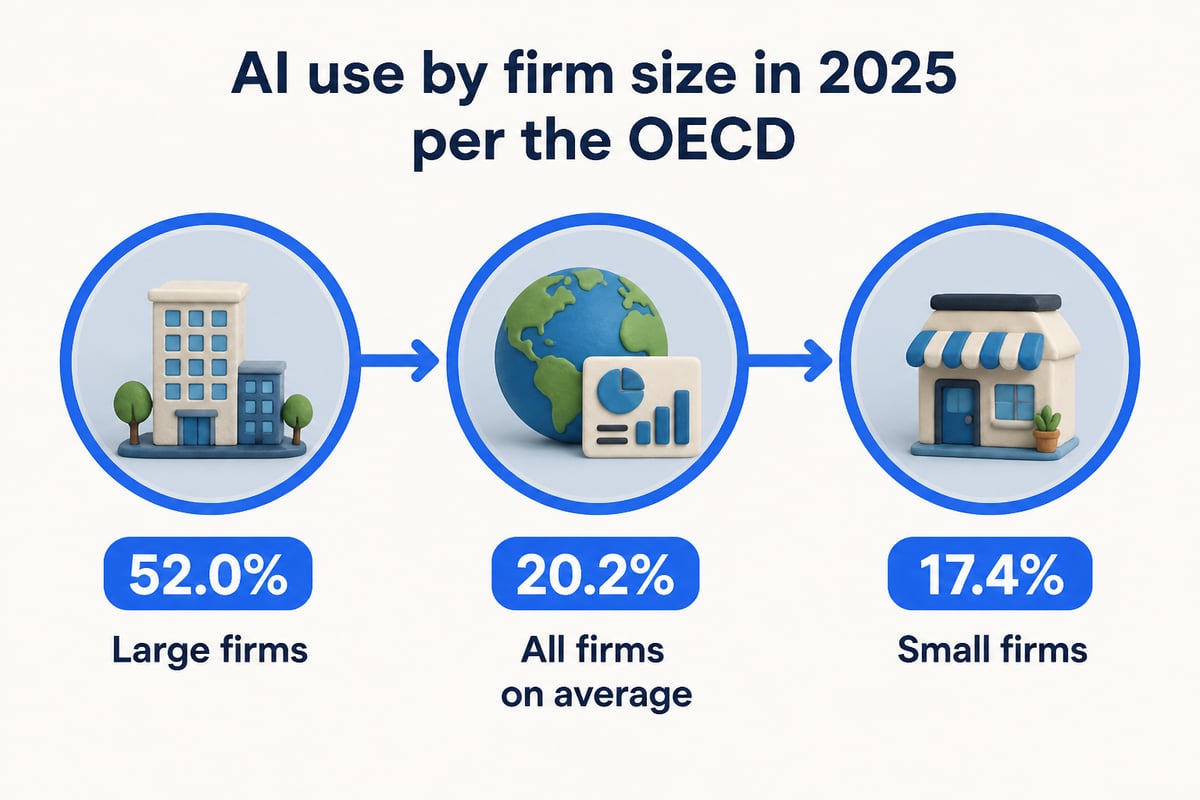
The OECD reported that 20.2% of firms across OECD countries with available data used AI in 2025. That was up from 14.2% in 2024 and 8.7% in 2023. The same report shows a gap by size: 52.0% of large firms used AI, compared with 17.4% of small firms.
That gap is your opening. A 20-person agency that automates lead follow-up can get ahead of the many small firms that have not started.
Money is moving too. A Deloitte survey of nearly 550 leaders found that 74% of surveyed organizations had invested in AI or generative AI over the prior year.
But spending is not the same as results. Many firms buy a tool, never finish setting it up, and drop it in three months. That is why the choice of partner matters more than the choice of model.
What Should an AI Automation Company Actually Build for You?
A good AI automation company builds narrow agents that each own one job. It does not sell you one giant "AI brain" that claims to do everything.
Take a marketing agency with 15 people. The owner wants to "use AI." That is too vague. A better list looks like this:
- A lead agent that replies to new inquiries in under five minutes and books calls.
- A support agent that answers client questions from your own documents.
- A reporting agent that pulls numbers each Friday and writes the client update.
- An ops agent that handles invoices and chases late payments.
Each agent has one task, one owner and one number you can track. When an agent has one job, it is easier to test, easier to fix and cheaper to run.
Ask any firm you talk to: "What is the smallest first agent you would build for us?" A strong answer names a real task and a real result. A weak answer says "we will start with a strategy phase."
Sales agents
Sales agents handle lead follow-up, qualify leads and book meetings. For a recruiting firm, this might mean screening candidate replies and sending the right ones to a recruiter.
Support agents
Support agents answer routine questions from clients or customers. Our write-up on AI customer service covers what these agents can and cannot handle.
Operations agents
Ops agents do the back-office work. Invoices, scheduling, data entry, weekly reports. This work is dull, and it eats hours. It is often the best place to start.
For more on how these pieces fit together, read about AI agents for business.
How Do You Compare AI Automation Companies Side by Side?
Compare them on the same six points, and write the answers down. Without a fixed list, every sales call sounds good.
| What to check | A good answer | A weak answer |
|---|---|---|
| First build | One named agent with one job | "A discovery phase" |
| Time to live | Days or a few weeks | "3 to 6 months" |
| Proof | Numbers from real use | Only logos and quotes |
| Ownership | You own the build and can train your team | You rent it and cannot leave |
| Cost control | Explains how model costs are kept low | Silent on usage costs |
| Support | Named person, clear response time | A shared inbox |
Run every firm through this table. Score each one out of 6. Drop anyone under 4.
One point deserves extra weight. Ask if your team can learn to build agents without the firm. If the answer is no, you are locked in. That is fine for some businesses, but you should choose it on purpose.
Which AI Agent Automation Tools Do These Companies Use?
Most AI automation companies build on a mix of workflow tools, large language models and your own apps. Knowing the common tools helps you judge what you are buying.
Here are the main categories, with real examples:
- Workflow builders. Zapier, Make and n8n connect your apps and move data between them. n8n can be self-hosted, which matters if you handle sensitive data.
- Enterprise platforms. Microsoft Power Automate, UiPath, Boomi and MuleSoft suit large firms with old systems.
- AI models. Claude, GPT and Gemini read text, write replies and make small decisions.
- Your own systems. Your CRM, email, calendar, helpdesk and billing tool.
If you want tools similar to Zapier, n8n and Make are the common picks. Zapier is easiest to start. n8n gives more control and can cost less at high volume. Power Automate fits teams that live in Microsoft 365.
A tool alone does not fix a slow process. A service firm with 10 people can buy Zapier in five minutes and still have no working agent a month later, because nobody designed the flow, tested the answers or watched the costs. That gap is what you pay a build partner to close.
What Questions Should You Ask Before You Sign?
Ask questions that force specific answers. Vague answers on a sales call turn into vague results later.
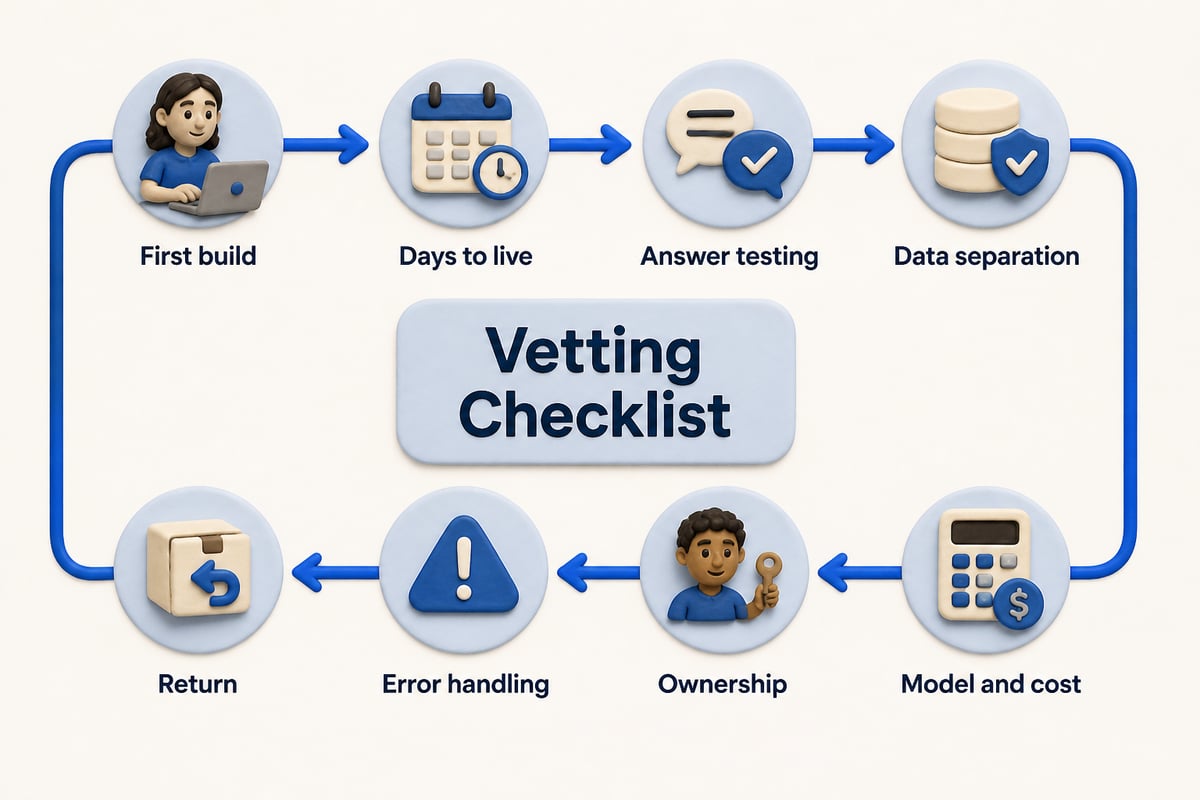
Use this list on every call:
- What will you build first, and what will it do each day?
- How many days until it is live, and what do you need from us?
- How do you test that the agent gives correct answers?
- How do you keep each client's data apart from the others?
- Which model do you use, and what happens to usage costs as volume grows?
- Who owns the agents, prompts and workflows when we finish?
- What happens when the agent gets something wrong?
- When can we expect to see a return, and how will we measure it?
Listen for numbers. "We resolve most tickets" is weak. "We resolved 17,000 tickets with no data mix-ups" is a claim you can check.
Question 4 is the one owners skip most. If an agent serves many users, it must keep their data separate. Imagine a support agent that tells one client about another client's invoice. One mistake like that can end a contract. Ask how the firm prevents it, and ask to see it.
How Fast Should an AI Automation Company Get You Live?
A good AI automation company gets one working agent live in weeks, not quarters. Two to six weeks is a fair range for a first narrow agent.
Compare two paths. A mid-sized firm hires a large consultancy. It spends eight weeks on a "readiness assessment," two more on a plan, and four months building. Total time to first result: about seven months.
Now a 20-person agency hires a build partner. Week one: pick the one job. Weeks two and three: build and test. Week four: live. Total time to first result: about one month.
The second path costs less and teaches you more. You see real results while the first firm is still writing slides. If the first agent fails, you lose a month, not a year.
Slow starts hurt in a second way. Your team loses interest. The owner moves on to other fires. The project dies in a drawer.
Ask each firm for a dated plan with a "live" date. Hold them to it.
How Do You Know If the Return Is Real?
You know the return is real when you can count it in hours saved, leads kept or tickets closed, and match it to money. Do not accept "improved efficiency" as a result.
Before any build starts, write down three numbers:
- How many hours the task takes now each week.
- What those hours cost you.
- What a lost lead or late reply costs you.
Say a support person spends 12 hours a week on repeat questions at $30 an hour. That is $360 a week, about $18,700 a year. An agent that handles most of those questions has a clear target to beat.
Measuring AI returns usually comes down to the same kinds of measures: financial results, revenue growth, cost savings and time to achieve results. Time matters. Ask the firm when you should expect to see a payback, and put that date in writing.
A fair target for a narrow agent is a visible return inside two months. If a firm cannot name a timeline, it has not thought about your outcome.
You can also test model costs. Use Vieerx's model calculator to see how model choice changes what you pay per run.
What Red Flags Should You Watch For?
The biggest red flags are vague scope, long timelines, no proof, and no clear answer on who owns the work. Any one of them is a reason to pause.
Watch for these:
- "We do everything." A firm with no focus has no depth.
- No named first build. If they cannot say what comes first, they have not built it before.
- Results with no numbers. "Clients love it" is not a result.
- Lock-in. You cannot see the workflows, or you cannot move them.
- No test plan. They cannot explain how they check answers.
- Pressure to sign today. Good firms let you think.
- Cheapest model for everything, or priciest for everything. A good build matches the model to the task.
That last point is easy to miss. A simple task, like sorting an email into a folder, does not need the most costly model. A hard task, like writing a careful client reply, may. A firm that picks the cheapest model that still passes its tests keeps your bills low without cutting quality.
Risk is also a legitimate concern. NIST published its Generative AI Profile on July 26, 2024, offering voluntary guidance on how to find and manage the risks of generative AI. You do not need to read all of it. But a serious firm should know it and be able to explain how it handles privacy, errors and oversight. NIST's broader AI Risk Management Framework explains how to build trust into the design, use and review of AI systems.
How Does Vieerx Approach AI Automation for Service Businesses?
Vieerx builds custom AI agents and puts them inside your business. It works with agencies and service businesses of 5 to 50 people, such as marketing agencies, recruiting firms, consultants, course sellers and SaaS founders.
Here is how the work runs:
- Every agent owns a single narrow job and runs without a human steering it.
- Each run uses the cheapest model that passes evaluation tests.
- You get a live working agent within 14 days of kick-off.
- A deployment crew trains your team to build agents without Vieerx.
- Each user gets separate memory, so no user's information mixes with another's.
The numbers behind it: 99.4% answer accuracy across 1,000+ users, and 17,169+ tickets resolved with zero mix-ups between users. The goal is real ROI in six weeks or less.
For readers who want the simplest starting point, the AI automation build covers workflows on n8n and Claude that do repeat work for you, like lead follow-up, booking, reporting and invoicing.
Vieerx is not the right pick for everyone. If you want a personal AI assistant for yourself, or a free self-serve chatbot with no setup, this is not it. Vieerx is for owners and managers who want agents built and installed in a real business.
Which Kind of AI Automation Company Fits Your Size and Goal?
The right firm depends on your team size, your tools and how much you want to learn yourself. Match the type of firm to your situation, not the other way around.
You run a 5 to 15 person service business. You need one or two agents fast, and you have no engineer. Pick a build partner that goes live in weeks and trains your team. See our notes on AI for small business for starter ideas.
You run sales, support or operations at a mid-sized firm. You need agents across several teams. Pick a partner that can build in your existing tools and keep data separate by user.
You want only advice, not a build. An AI consultant can map the work. Read about AI consulting to see what that gets you, and where it stops.
You are a large firm with old systems. Enterprise platforms like UiPath, Boomi or MuleSoft may fit better.
A simple rule: if you can name the task, hire a builder. If you cannot name it yet, start with a short planning call, then build.
A Simple Five-Step Plan to Pick Your Partner
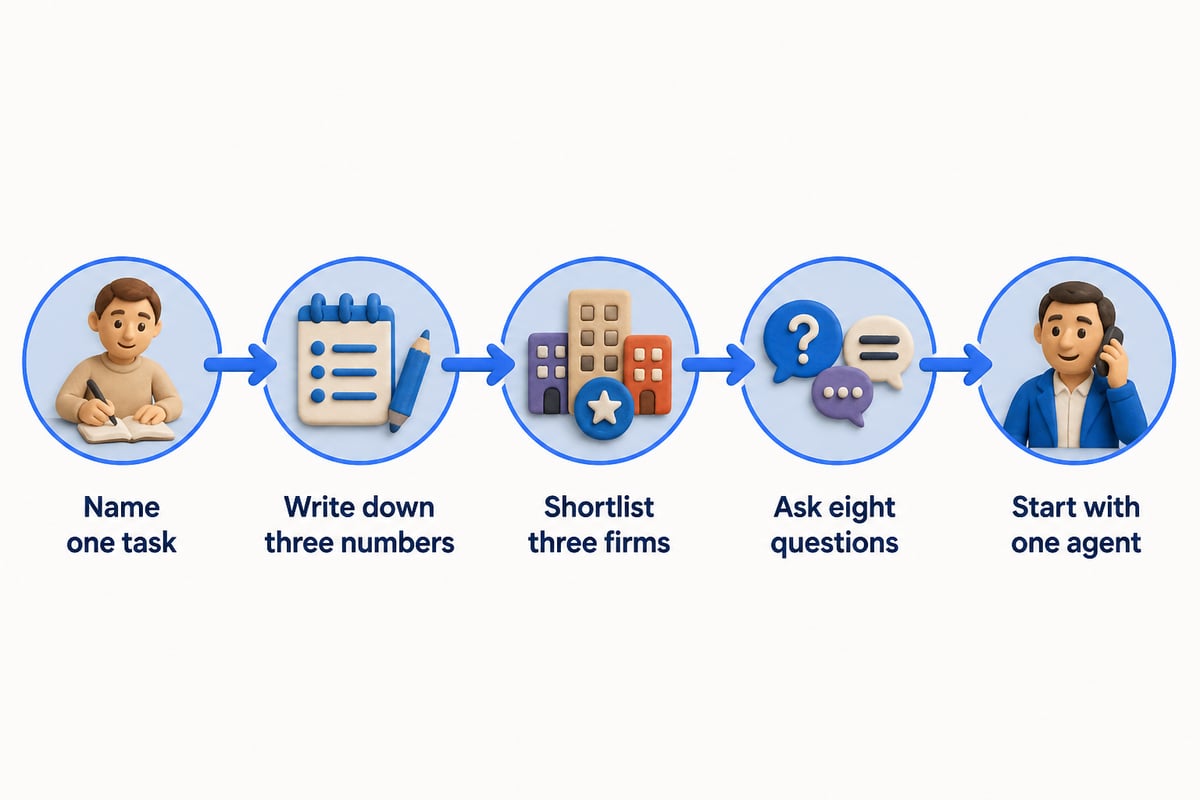
You can pick a partner in about two weeks if you follow a fixed plan. Here it is.
- Name one task. Choose the repeat job that costs the most hours or loses the most leads.
- Write down your three numbers. Hours per week, cost per hour, cost of a missed lead.
- Shortlist three firms. Use the six-point table above.
- Ask the eight questions. Take notes. Compare answers side by side.
- Start small. Sign for one agent, with a live date and a way to measure the result.
Do not start with five agents. Start with one. Prove it. Then add more.
A recruiting firm that starts with lead follow-up, sees more booked calls in a month, and then adds a candidate-screening agent has built trust and proof. A firm that tries to automate everything at once usually ends up with nothing finished.
FAQ
What are the best AI agent automation tools?
The most used tools are Zapier, Make and n8n for connecting apps, and Microsoft Power Automate for Microsoft teams. AI models like Claude, GPT and Gemini handle the reading and writing. Most service businesses get better results when a build partner sets these up for one clear job.
What are some tools similar to Zapier?
Make and n8n are the two most common picks. Make is visual and low cost. n8n can be self-hosted, which helps when you handle sensitive data. Power Automate is a strong choice if your team works in Microsoft 365.
How much should I expect to wait before an AI automation company shows results?
For one narrow agent, two to six weeks to go live is a fair range, and visible return inside about two months is a reasonable goal. If a firm quotes many months before anything works, ask why. Set a live date and a number to measure before you sign.
Your next step is simple: write down the one repeat task that costs your team the most hours each week, and put a dollar figure on it. Then bring it to a call. Vieerx builds custom AI agents for agencies and service businesses of 5 to 50 people, and it can start with a single job through its AI automation build. Book a free demo with Vieerx and see a working agent plan for your business, then book your free demo at https://cal.com/tanvieerx/agentic-review.