
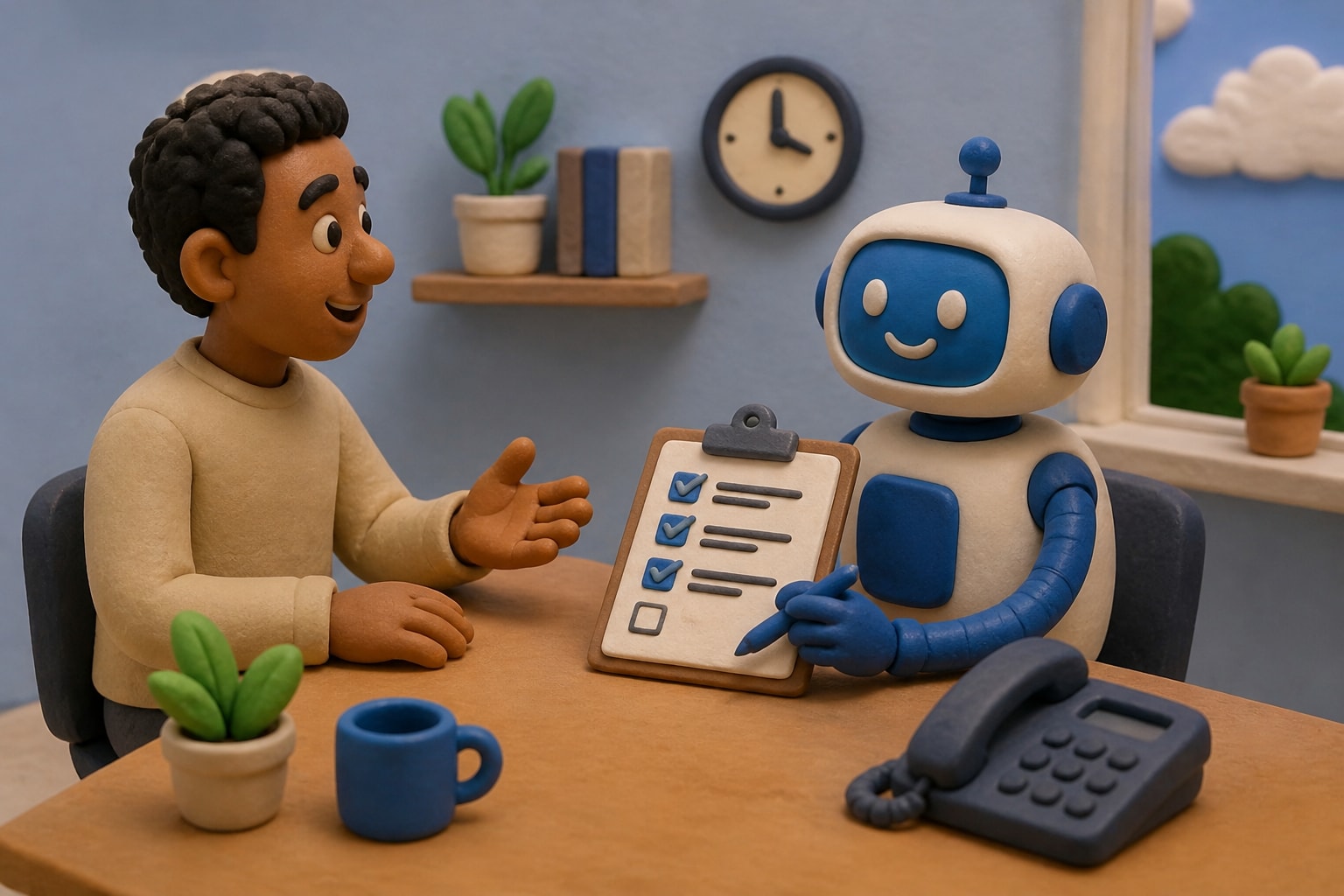
An AI sales agent is software that does one sales job on its own, like replying to new leads, following up, or booking calls, without a person steering each step. It works inside your email, CRM and calendar. It does not replace your closer. It handles the slow, repeat work that eats your week.
This guide is for owners and heads of sales at agencies, recruiting firms, consultants and clinics. You will see what these agents do, what they cost, where they break and how to start.
What does an AI sales agent actually do?
An AI sales agent takes a narrow sales task and finishes it from start to end, with no human prompting it.
Hypothetical example: a web design agency gets a form fill late at night when nobody is online. The agent replies, asks two qualifying questions and offers call times. When the lead answers, the agent books the call and sends a short brief to the owner.
Nothing in that story needed a person until the call itself.
Common jobs an AI sales agent can own:
- Lead response. Reply to new leads in minutes, any hour.
- Follow-up. Send the second, third and fourth touch when a lead goes quiet.
- Qualifying. Ask budget, timeline and need questions, then score the answers.
- Booking. Offer times, confirm, reschedule and send reminders.
- CRM upkeep. Log every email, call note and deal stage change.
- Reactivation. Message old leads who never bought.
The key word is narrow. One agent, one job. An agent told to "do sales" will do it badly. An agent told to "reply to every inbound lead within five minutes and book a call" will do it well. We cover that design idea more in our post on AI in sales.
How is an AI sales agent different from a chatbot?
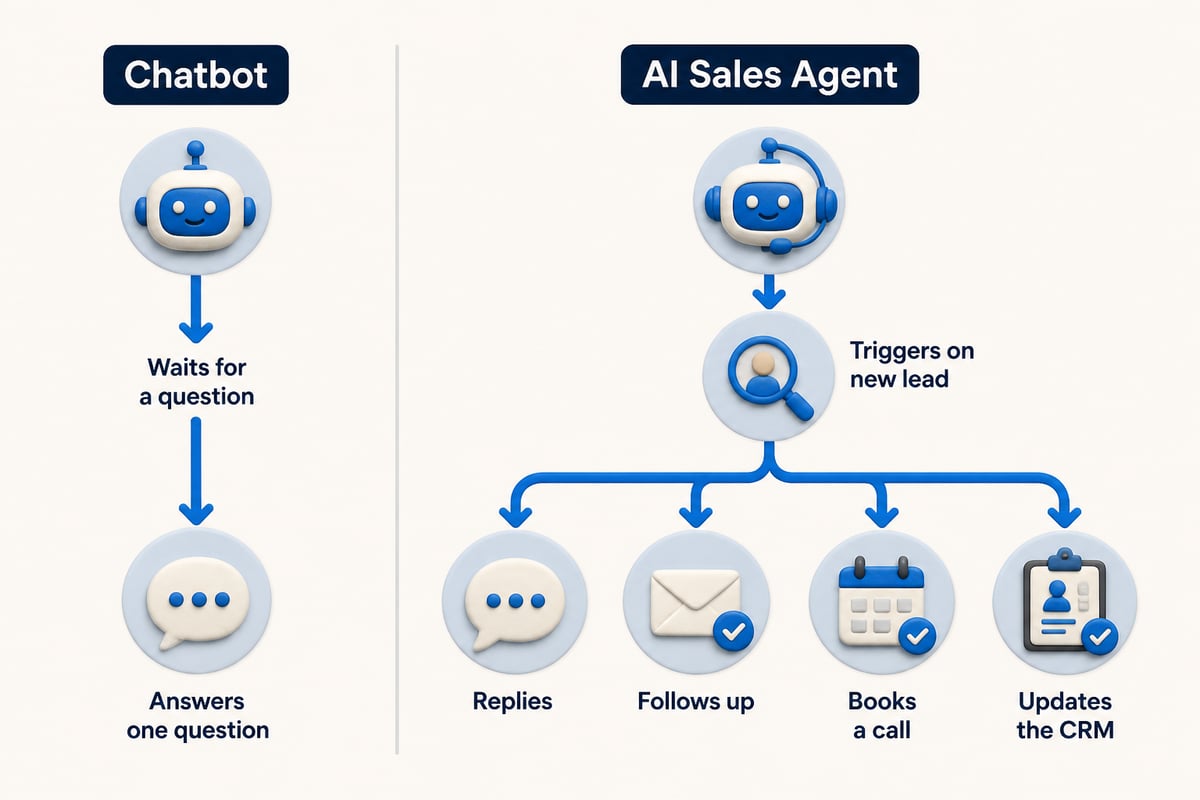
A chatbot answers questions when someone types. An AI sales agent takes action on its own, across your tools, whether or not anyone is talking to it.
Think of a chatbot on your site. A visitor asks "How much do you charge?" and it gives an answer. Then the visitor leaves, and nothing else happens.
Now think of an agent. It sees the visitor left an email. It checks the CRM, finds no past deal, writes a follow-up, waits two days, sends a second note with a case-relevant question, and books a call when the lead says yes. It also updates the CRM and pings you on a hot lead.
| Chatbot | AI sales agent | |
|---|---|---|
| Starts on its own | No, waits for a message | Yes, triggers on events and schedules |
| Works across tools | Rarely | CRM, email, calendar, phone |
| Remembers the lead | Often per chat only | Keeps memory per lead |
| Finishes a task | Answers a question | Books the call, sends the follow-up, logs it |
| Needs a human to steer | Often | No, within its set job |
If you want a chat window on your site, a business chatbot may be enough. If you want leads worked and calls booked, you want an agent.
Why are service businesses adopting AI sales agents now?
Service businesses adopt them because response time wins deals, and small teams cannot answer every lead fast.
When a small team is on calls, leads can wait a long time for a reply. Buyers often talk to several firms, and the firm that answers first often gets the call.
The numbers show owners are already moving. A 2025 survey of 400 U.S. small-business owners by Talkdesk found that 51% had put AI into customer service. Among those using AI, 65% reported faster resolution times, 60% reported round-the-clock support and 18% reported increased sales through AI-enabled access to information.
Verizon's 2025 State of Small Business survey of U.S. small and midsize business owners found that many were using AI in at least one way. Nearly a quarter used AI digital assistants for customer service.
Those are broad business numbers, not sales-agent numbers. But they tell you the tools are normal now. Your competitors are likely testing them.
There is also research on the human side. A study of 5,172 customer-support agents, posted as an NBER working paper on arXiv, found that generative-AI help raised issues resolved per hour by 15% on average. The gains were not equal across workers. Expect the same in sales: some of your people will gain more than others.
What can an AI sales agent handle, and what should stay human?
Give the agent anything that is repeat, rule-based and time-sensitive. Keep anything that needs trust, judgment or a deal on the line with a person.
Hand to the agent:
- First reply to inbound leads
- Follow-up sequences that adjust to replies
- Meeting booking and reminders
- No-show recovery
- CRM data entry
- Pre-call research briefs
- Reactivating cold leads
Keep with your team:
- Pricing talks on large deals
- Handling an angry or upset buyer
- Custom scoping for complex work
- Final negotiation
- Relationship calls with your best accounts
Hypothetical example: a consulting firm sells high-value advisory projects. The agent answers inquiries, asks about company size and the problem, and books only leads that fit. A partner takes the call and still does the selling. The agent clears the path.
If your offer is cheap and simple, such as a course or a low-cost service plan, the agent can go further, including taking a booking and payment. If your offer is expensive and custom, keep it to the front half of the funnel.
How much does an AI sales agent cost?
Cost depends on whether you buy a tool, hire a freelancer or have a team build a custom agent, and each path ranges from tens of dollars a month to a few thousand dollars up front.
Three common routes:
- Off-the-shelf SaaS tools. Low monthly fees. You set it up yourself. Good for simple jobs, weak when your process is unusual.
- Freelancer or no-code builds. One-time build fee plus your own upkeep. Quality varies a lot.
- Custom build by an agency. Higher up-front cost. The agent is shaped to your offer, tools and rules, and someone else carries the setup work.
Do not look only at the price tag. Look at what you pay in model costs each run. Vieerx runs each task on the cheapest model that passes evaluation tests, which keeps per-lead cost down. You can estimate your own numbers with the model cost calculator.
For exact Vieerx pricing, use the contact page or book a demo rather than guessing from a blog post.
A simple way to judge cost: take your average deal value, your close rate and how many leads you lose to slow replies each month. If you lose even two deals a month at $3,000 each, a build pays for itself fast. If you lose none, wait.
Do AI sales agents get paid, and what does an AI salesman make?
An AI sales agent does not get a salary, commission or benefits. You pay for the software, the build and the model usage instead.
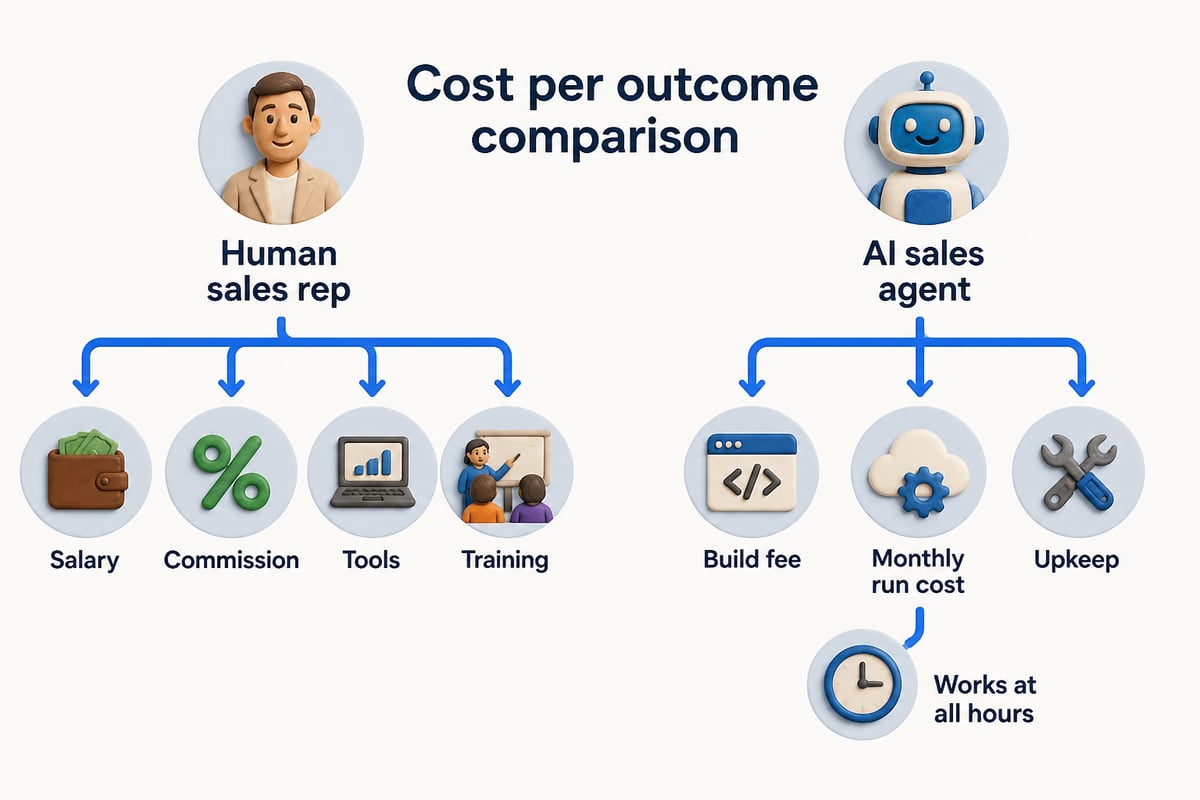
People ask "how much does an AI salesman make" because they compare it to a human rep. The honest comparison is cost per outcome, not pay.
A human sales rep costs a base salary, commission, tools, training and management time. They also work set hours, take vacation and quit. An agent costs a build fee, a monthly run cost and some upkeep. It works at 3 a.m. and does not forget a follow-up.
But an agent also cannot close a hard deal alone. It does not earn a commission because it does not close in the way a person does. Treat it as a very fast assistant that raises the output of your people. Do not treat it as a rep with a quota.
Will AI replace sales agents?
AI will replace tasks inside sales jobs long before it replaces the jobs themselves.
Look at what a rep does in a week. Some of it is selling: calls, trust, closing. A lot of it is not: logging notes, chasing replies, writing the same follow-up, checking the calendar. The second pile is what agents take first.
Hypothetical example: a five-person agency has two people who split sales with delivery. Today they spend about a third of their sales time on admin and chasing. If an agent takes most of that, the same two people can talk to more qualified buyers without hiring a third seller.
That is the real shift. You do not need fewer closers. You need your closers on calls, not in inboxes.
Roles that lean on pure lead handling, such as simple inbound qualifying, face the most change. Roles built on trust and complex deals face the least. Plan for a mixed team, not an empty one. Our piece on AI agents for business goes deeper on this split.
What are the main types of AI sales agents?
The main types are inbound responders, outbound prospecting agents, follow-up agents, voice agents and CRM agents, and most service businesses need only one or two.
Here is the list, with who each one suits:
- Inbound responder. Replies to form fills, emails and chats at once. Best for firms with steady inbound but slow replies.
- Follow-up agent. Works leads that go quiet. Best for firms with a long sales cycle.
- Outbound prospecting agent. Finds and messages cold leads. Needs clean targeting and tight rules to avoid spam.
- Voice agent. Answers and makes calls. Best for clinics and home services where leads phone first. See our guide to the AI voice agent.
- CRM agent. Keeps records clean, updates stages and flags stuck deals. Pairs well with any other type. See AI CRM.
You asked about "top agents," so a note on that. There is no single best agent for everyone. The best one is the one that fits the leak in your pipeline. Find where leads drop. Build for that spot first.
How do you set up an AI sales agent step by step?
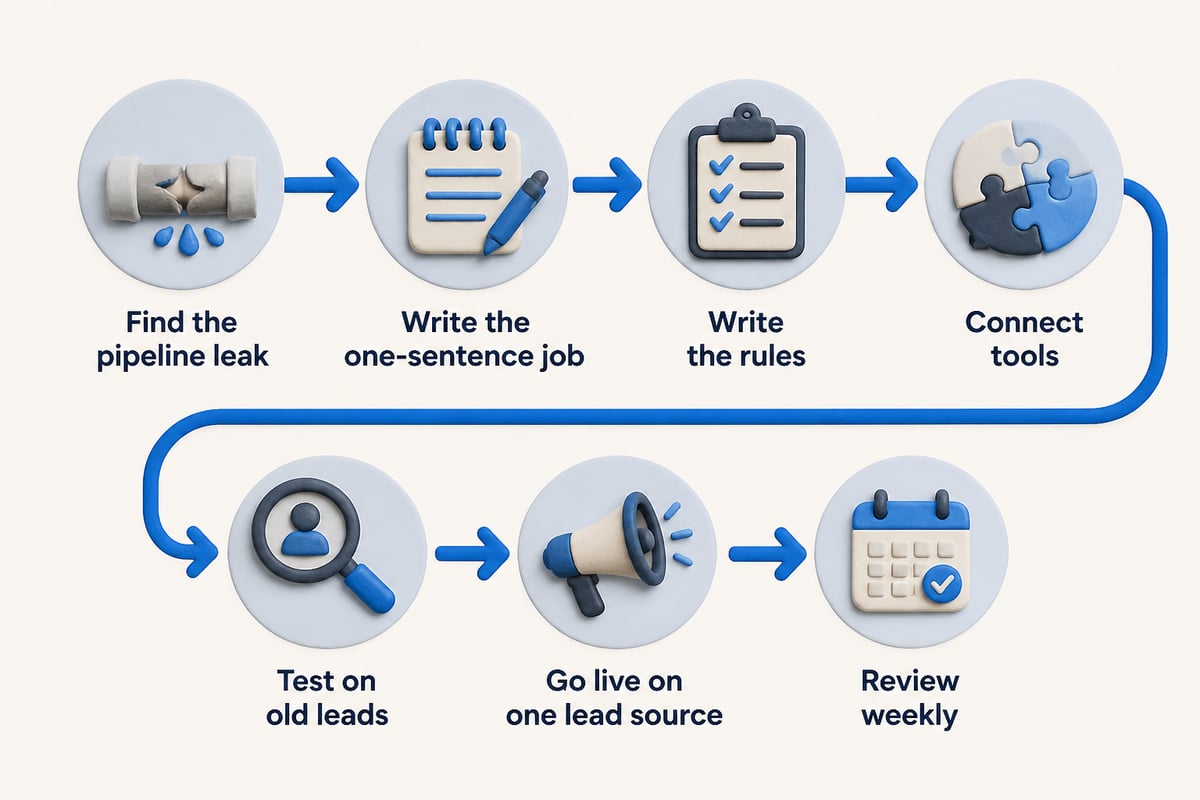
Pick one leak in your pipeline, define one job, connect your tools, test on real past leads, then go live with a human watching.
- Find the leak. Pull the last 50 leads. Count how many got a reply in under 5 minutes, how many got a second follow-up and how many booked. The weakest step is your first job.
- Write the job in one sentence. "Reply to every new lead in five minutes and book a call." If you need "and" more than twice, split it.
- Write the rules. What it may say. What it may never say. When it hands off to a person. What counts as a qualified lead.
- Connect your tools. CRM, email, calendar and any form or ad source. Clean your CRM fields first, since a messy CRM makes a messy agent.
- Test on old leads. Run it on past leads in a sandbox. Read every message it would send.
- Go live in a small slice. Start with one lead source. Watch the first 50 conversations.
- Review weekly. Check booked calls, handoffs and any bad replies. Tune the rules.
The point of the rules in step 3 is control. A good agent knows its edges. When a lead asks for a discount, a legal promise or anything outside its job, it stops and passes the lead to you.
Can you trust an AI sales agent with your leads?
You can trust an agent as far as you test it, limit its job and watch its output.
The risks are real. An agent can state a wrong price, promise something you cannot deliver, or mix up two leads. Each risk has a fix:
- Wrong claims. Give it a fixed source of truth: your offer, your price ranges, your policies. Tell it to say "I will check with the team" when unsure.
- Mixed-up leads. Use separate memory for each lead. Vieerx builds agents so each user gets separate memory.
- Bad tone. Write tone rules and sample replies. Review the first 50 messages.
- Privacy. Collect only what you need. Know where lead data is stored.
- Drift. Models and prompts change. Re-run your test set each month.
For a formal way to think about this, the U.S. NIST AI Risk Management Framework gives a plain structure for finding and managing AI risks. NIST also released a Generative AI Profile on July 26, 2024, as a companion to that framework. You do not need to follow it to the letter at 20 people. But its basic habits, map the risks, measure them, manage them and assign an owner, are a good checklist.
On accuracy, ask any builder for test numbers, and ask how they test. A vendor with no test numbers is a warning sign.
What mistakes make AI sales agents fail?
Most failures come from vague jobs, bad data and no human check, not from the AI itself.
Hypothetical example: a business turns on an agent to "handle all sales" with no clear rules. The replies run long and pushy, and the agent books calls with poor-fit leads. The owner turns it off, but the real problem was a job that was too wide.
Watch for these:
- Too many jobs in one agent. Split them.
- Dirty CRM. Duplicate contacts and empty fields lead to bad replies.
- No handoff rule. The agent keeps talking when it should stop.
- No tracking. If you do not count booked calls and replies, you cannot tell if it works.
- Spammy outbound. Mass cold messages hurt your domain and brand. Keep volume low and targeting tight.
- Set and forget. Check the agent every week for the first month, then every month.
One more point: do not buy a tool and hope your team will "figure it out." Someone on your side needs to own it. One person, a few hours a week at the start.
How do you measure whether an AI sales agent works?
Measure speed to reply, booked calls, show rate and cost per booked call, and compare them to your numbers from before the agent.
Before you launch, write down your baseline for 30 days. Then track:
- Time to first reply. Aim for minutes, not hours.
- Reply rate. Percent of leads who answer the first message.
- Booked calls per 100 leads.
- Show rate. Percent who attend the call.
- Handoff rate. How often the agent passes a lead to a human. Too high means weak rules. Too low may mean it is overreaching.
- Cost per booked call. Build cost plus run cost, divided by calls.
- Revenue touched. Deals that began with the agent.
Give it a fair window. A useful yardstick: if you see no movement in your numbers by week six, the job or the rules need a rethink.
Keep a simple weekly sheet. Five numbers, one line each. If you cannot read your agent's results in two minutes, the setup is too complex.
How does Vieerx build an AI sales agent for a service business?
Vieerx builds a custom agent for one narrow job, connects it to your tools and has it live within 14 days of kick-off.
The approach follows the same rules covered above. Every agent owns a single narrow job and runs without a human steering it. Each run uses the cheapest model that passes evaluation tests. Each user gets separate memory. And a deployment crew trains your team to build agents without Vieerx, so you are not stuck.
Vieerx works with agencies and service businesses of 5 to 50 people: marketing agencies, recruiting firms, consultants, course sellers and SaaS founders. These are owners who know AI matters but do not know what to build first or who to trust to build it. The answer to "what first" is usually the leak you found in the setup steps: slow reply, weak follow-up or no-shows.
If you want the build handled for you, the custom AI agents service covers sales, support and ops agents plugged into your tools. For a wider view of how agents link steps together, read about agentic workflows. If you are not a fit for a build, for example you want a free self-serve chatbot with no setup, a basic chatbot tool is the better route.
FAQ
Can an AI sales agent close deals by itself?
For simple, low-cost offers, an agent can take a booking or a payment on its own. For larger or custom deals, it should qualify the lead and book the call, then pass the lead to a person who closes.
How long does it take to get an AI sales agent running?
A simple, single-job agent can go live in about two weeks when the CRM and offer are clear. Testing on real leads and weekly reviews follow after that.
Do I need a big team or a clean CRM to start?
You do not need a big team. One owner of the project is enough. You do need basic CRM order, with one record per lead and key fields filled in, because the agent reads from it. Cleaning that up first saves weeks later.
Pull your last 50 leads this week and count how many got a reply in under five minutes, because that number shows you where an agent should start. If you want a team to build and run that agent for you, Vieerx is an AI integration agency that builds custom sales, support and ops agents for businesses of 5 to 50 people, and its custom AI agents service is built to go live quickly. You can book a free demo with Vieerx at Vieerx and see your own pipeline run through an agent.